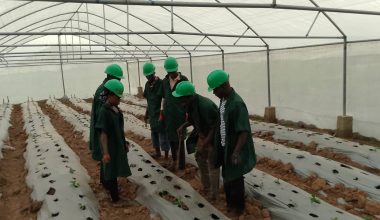
 Greenhouses
Crops to Plant in April in Nigeria — What to Grow This Planting Season

April is one of the most important months for Nigerian farmers. In the south-south and southeast, rains are already consistent. In the southwest and middle belt, early rains are making the soil workable. Even in the north, farmers planting early with irrigation are already ahead. Whether you’re farming commercially or managing a smallholder plot, here is a practical guide to what you should be planting right now — and what inputs to have ready.
1. Tomatoes
Tomatoes are one of Nigeria’s highest-demand crops and April is ideal for transplanting seedlings started in March, or for direct sowing in early April. The April–July growing window allows harvest before the peak of the rainy season when disease pressure is highest.
Best varieties for April: Cobra 26 F1, UC82, Platinum F1, Tomimaru Muchoo. F1 hybrid varieties give significantly higher yield and better disease resistance than open-pollinated types.
Inputs you need: F1 tomato seeds, nursery trays, NPK 15:15:15 for basal application, Urea for top dressing, a systemic fungicide (Ridomil Gold or Blue Snow) for early blight prevention, and an insecticide (Tihan or Belt Expert) for thrips and fruit borer control.
Browse tomato seeds on Farmsquare →
2. Habanero Pepper (Tatashe & Scotch Bonnet)
Pepper is a cash crop with strong year-round demand across Nigeria. April planting — whether habanero, tatashe (bell pepper), or scotch bonnet — gives you a harvest window around July–September when market prices tend to be favourable.
Best varieties for April: Nikita F1 (sweet pepper), Etna F1 (habanero), Super Habanero F1. Transplant seedlings that were started 6–8 weeks ago, or begin new seedlings now for a slightly later harvest.
Inputs you need: Pepper seeds or healthy seedlings, nursery trays, drip irrigation if you are in a drier zone, NPK fertiliser, and a broad-spectrum insecticide to manage aphids and whiteflies which are peak threats in April.
3. Cucumber
Cucumber is one of Nigeria’s fastest-growing crops — harvest begins as early as 45–55 days after planting. The April planting window takes advantage of warm temperatures and early rains to deliver a quick return.
Best varieties for April: Darina F1 (high yield, disease resistant), Mydas RZ F1 (long shelf life, popular with commercial farmers), Farmers Pride F1. Direct seed into prepared ridges or beds.
Inputs you need: F1 cucumber seeds, drip tape or flood irrigation, NPK fertiliser, Amprolium or Velum Prime for root nematode management in infested soils, and a fungicide to manage powdery mildew.
4. Watermelon
April through June is peak watermelon planting season in Nigeria. The crop matures in 70–90 days and the harvest lands just as the dry season begins again, when demand and prices are strong. Watermelon is well-suited to the middle belt, Osun, Oyo, Niger, and Kano states.
Best varieties for April: Elghali F1, Grey Top F1, Charleston Grey. Plant seeds directly into well-prepared mounds with good spacing (2m x 2m).
Inputs you need: Watermelon seeds, potassium-rich fertiliser (MOP or SOP) for fruit development, Ampligo or Confidor for fruit fly control, and Ridomil Gold for gummy stem blight prevention.
5. Maize (Corn)
The April planting of maize takes advantage of the first rains and positions harvest for July–August, before the second season competition drives down prices. Hybrid maize varieties can yield 5–8 tonnes per hectare with proper management.
Best varieties for April: Dekalb DKC 8031, TELA Sammaz, OBA Super 2. Plant at 75cm × 25cm spacing with one seed per hole.
Inputs you need: Certified hybrid maize seeds, NPK 15:15:15 at planting, Urea top-dressing at 3–4 weeks, Atrazine herbicide for weed control within the first 2–3 weeks, and Lambda-cyhalothrin for stem borer management.
6. Okra
Okra is fast-maturing, drought-tolerant once established, and has consistent urban market demand. April planting gives you harvest from late June onward. It is one of the easiest crops for smallholder farmers to manage alongside other crops.
Best varieties for April: Clemson Spineless, LD88, Kirikou (small fruited, high-value for export). Direct sow two seeds per hole, thin to one after germination.
Inputs you need: Okra seeds, NPK fertiliser, Karate or Lambda insecticide for aphids, and adequate spacing (60cm × 30cm) to reduce humidity-related leaf diseases.
7. Leafy Vegetables (Amaranth, Kale, Parsley)
April is an excellent time to plant leafy greens in most of southern Nigeria. These crops mature in as little as 30–45 days, providing quick cash flow for smallholder farmers. They are particularly valuable in peri-urban areas where fresh vegetable demand is consistent year-round.
Inputs you need: Vegetable seeds, a light NPK fertiliser application, and consistent watering. Shade nets can reduce heat stress during peak afternoon sun.
April Planting Checklist
Before you go to the farm this week, make sure you have:
- ✅ Quality F1 seeds or certified variety seeds for your chosen crop
- ✅ Basal fertiliser (NPK 15:15:15 or NPK 20:10:10 depending on crop)
- ✅ Top-dressing fertiliser (Urea or CAN) for 3–4 weeks after planting
- ✅ Pre-emergence or post-emergence herbicide for weed management
- ✅ Insecticide and fungicide for pest and disease management
- ✅ Irrigation plan — even if you are rain-fed, have a backup plan for gaps
- ✅ Knapsack sprayer in good working condition
All of these inputs are available at farmsquare.ng with nationwide delivery. If you are buying in bulk for a large farm or cooperative, request wholesale pricing here.
Have questions about what to plant on your specific farm? Send us a WhatsApp message on +234 902 244 4522 and one of our agronomists will advise you.


